Healthcare & teamwork
Practitioner-Centered Design: A Case Study of a Human-Computer Interaction-Clinician Collaboration on the Development of Prototype Virtual Reality Environments for the Treatment of Posttraumatic Stress Disorder and Moral Injury in Health Care Workers
A case study of how HCI and clinical teams collaborated to build prototype VR environments for PTSD and moral injury treatment among health care workers.
Jonathan I. Segal, Michael L. Turman, Mariel Emrich, S. Isabelle McLeod Daphnis, Samuel Rodriguez, JoAnn Difede, Andrea Stevenson Won
The research at a glance
How can HCI researchers and clinicians turn treatment goals into meaningful VR prototypes together?
Approach
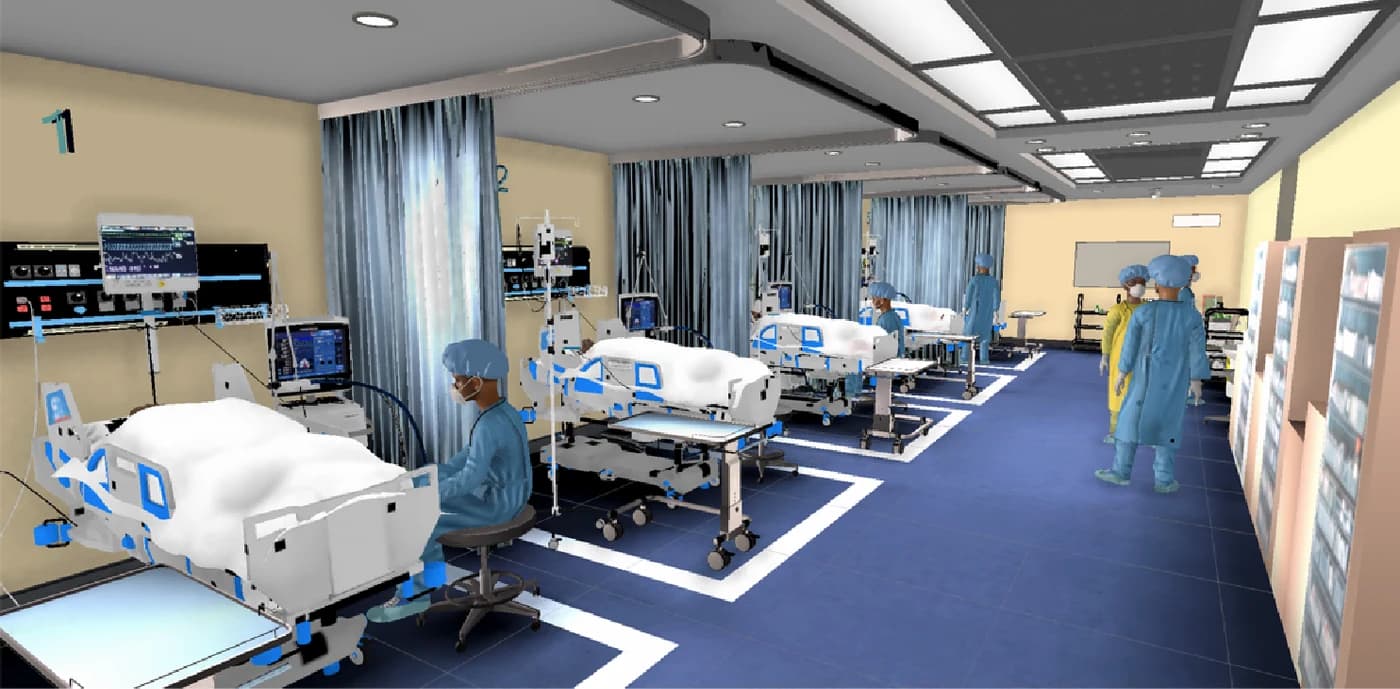
A case study follows an interdisciplinary collaboration building prototype VR environments for PTSD and moral injury treatment among healthcare workers.
Takeaway
Bridge roles, shared artifacts, and iterative feedback help connect clinical goals with technical design decisions and make interdisciplinary collaboration more workable.
A collaboration case study about prototype development, rather than an evaluation of treatment efficacy.
Abstract
Virtual reality-based psychotherapies require close collaboration between technical and clinical experts. This case study describes an HCI-clinician collaboration developing prototype immersive environments for posttraumatic stress disorder and moral injury in health care workers. It details how the team established communication, navigated differences in expectations and disciplinary knowledge, and used bridge roles, shared artifacts, and iterative feedback to align clinical goals with technical design decisions.
Contributions
- Documents a practitioner-centered collaboration process for building clinically meaningful VR therapy prototypes.
- Describes the bridge role as a mechanism for translating clinical goals, technical constraints, terminology, and feedback.
- Distills guidelines for XR-health collaborations: staged fidelity, privacy-aware data paths, shared change logs, and cue prioritization.
Citation
@article{segal2026practitioner,
  title={Practitioner-Centered Design: A Case Study of a Human-Computer Interaction-Clinician Collaboration on the Development of Prototype Virtual Reality Environments for the Treatment of Posttraumatic Stress Disorder and Moral Injury in Health Care Workers},
  author={Segal, Jonathan I. and Turman, Michael L. and Emrich, Mariel and McLeod Daphnis, S. Isabelle and Rodriguez, Samuel and Difede, JoAnn and Won, Andrea Stevenson},
  journal={Journal of Medical Extended Reality},
  volume={3},
  number={1},
  pages={14--23},
  year={2026},
  doi={10.1177/29941520261419919}
}